
Since I started writing about xAI – the two questions that have propelled me have always been the same.
The xAI files
Every essay in this series is pinned to a question on the board at rachelandthecity.com/the-xai-files.
Has xAI broken any laws – or are the laws too outdated or too convoluted to enforce?
And that’s an important distinction – because the solutions to these issues are completely different.
My thesis has always been: why follow a path that doesn’t lead to where you want to go?
This is a story about a convoluted law that seems impossible to enforce.
The law is Southaven’s noise ordinance. People think the noise is coming from the data centers – but in this fight, it’s not. The noise is coming from xAI’s power plant – a yard of gas turbines at 2875 Stanton Road, just below the TN line. The plant powers xAI’s Colossus II data center in Memphis and its newer data center in Southaven – and the people who live around it say it roars and hums all night.
The city’s stance is that the plant has never broken the city’s noise law. Southaven Mayor Darren Musselwhite says it over and over – “They have never been in violation of any noise ordinance here.”
So let’s actually read the law – because it’s online, and it’s pretty useless.
Southaven wrote its noise law in 1993 – and it starts out sounding great. It says every resident “is entitled to live in an environment free from excessive, unnecessary or offensive noise.” It even has a rule against noise that bothers people where they sleep, at night, or all the time.
But in 2000, the city added an exemption for industrial land – and that’s where this law falls apart.
If a plant on industrial land stays at or under 70 decibels at its property line, the whole noise law doesn’t apply to it – not the part about sleep, not the part about nighttime, none of it. So 70 works more like a free pass than a limit – and everything under it is fair game.
Then look at where it gets measured – at the property line, not at anybody’s house.
In May, the DeSoto Times reported readings as high as 70 in Colonial Hills, one of the neighborhoods by the plant, and said the mayor’s own meter had read anywhere from 39 to 70 as he walked the woods and neighborhoods from Tulane Road to Colonial Hills.
Those neighborhoods are farther from the turbines than the fence is – and the mayor says the company built a sound wall on the side facing the houses. So if it’s hitting 70 out where people live, what does it read at the fence? The mayor hasn’t said, and that’s one of the things I’ve used the open records laws to ask the city for.
Now, there’s also another catch – and it’s hiding in the letters “dBA.” That’s the scale the law uses to measure the noise, and the “A” matters. It stands for a setting on the sound meter called A-weighting, which was built to match how our ears hear everyday sounds like voices and traffic.
The catch is that our ears don’t pick up really deep, low sounds very well – so the A setting counts those sounds for less. Before the meter gives you a number, it shaves a big chunk off anything low and rumbly.
That’s fine if you’re measuring a lawnmower. It’s not fine if you’re measuring a hum. Low sounds carry farther, and they go right through walls and windows – so a hum can keep you up at night while the meter says it’s not that loud.
And the mayor himself calls this noise “a low frequency continuous hum.” So the scale written into the law turns down the exact sound people are complaining about. There are other settings that count low sounds fully – Southaven’s law just doesn’t use them.
So what happens when you complain?
The law says enforcement “shall be the responsibility of the chief of police or his designee” – and that’s about it. The part of the law that explained how to measure noise was repealed in 2007, along with the noise standards for outside and inside your house.
Nothing in what’s left says an officer has to come out, and nothing says anybody has to take a reading.
And when Jason Haley and two of his neighbors sued xAI over the noise in June, xAI’s lawyers used that same line to argue that neighbors can’t enforce the noise law at all – only the city can.
The state isn’t going to step in, either – it already said so.
When people raised the noise during the state air permit, Mississippi’s environmental agency wrote back, “MDEQ has no authority in the regulation of decibel levels.” So the city’s 1993 law is the noise rule that’s left.
Even if somebody did catch the plant over 70, the most the law allows is a $1,000 fine a day – for each day it happens. This is a company the governor’s office says is investing $20 billion in Southaven.
And the mayor doesn’t even think 70 is OK. In May he said, “70 was never acceptable.” He said he’d asked xAI to keep it under 50, and he said, “When it is up to 58, I would not want to live there.” On October 1st he said he’d “demanded decibel levels be kept at a level significantly below what the ordinance states.”
But a demand isn’t a law – it’s still just a request. The law still says 70, at the fence, on a scale that turns the hum down.
My question is this – if this is a $20 billion investment, why can’t Southaven take some of those tax dollars and pay for a few real noise monitors – at the fence line and out in the neighborhoods, running all day and night, posted online where anybody can see them? If the noise goes over the line, the monitor flags it and somebody gets notified. The first time, xAI gets a warning – after that, the fines start, and they grow every time.
This seems like a pretty straightforward solution.
But what it doesn’t address is the entire crux of the issue.
These rules were written for a different kind of plant – in Southaven and in Memphis. Southaven’s noise law dates to 1993 and its industrial exemption to 2000, long before anybody here was building data centers that run their own power plants.
Southaven’s own planning director said last month that data centers are “allowed by right” under the city’s industrial zoning – so they don’t get a special rule at all. And when the city approved a new xAI building in September, its own agenda called it a “storage warehouse.”
It’s the same story across the state line.
Memphis’s zoning code – all 566 pages of it – doesn’t use the words “data center” one time.
So Colossus I went into the old Electrolux factory on Paul R. Lowry Road as an alteration to an existing building – no new building permit for the data center, no rezoning, no zoning hearing – with a certificate of occupancy on file by July 2024.
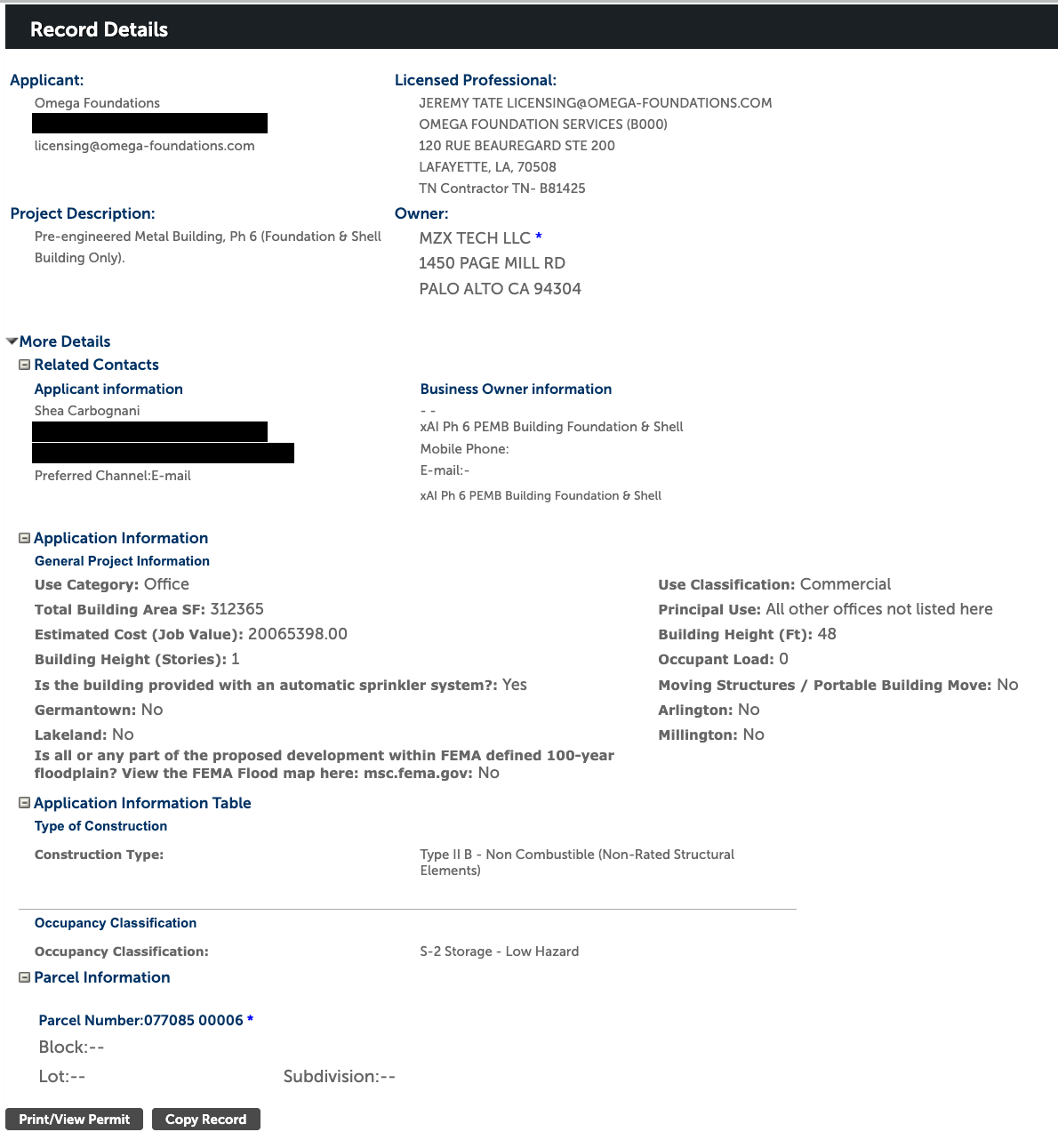
And when xAI pulled a permit this spring for a new 312,365 square foot building on Tulane Road, where Colossus II sits, the city filed it as an “Office,” with a “Storage” occupancy and an occupant load of zero. The forms only have the boxes they have – so that’s what they used.
And as far as Southaven’s written law goes, nothing’s changed since xAI showed up.
Look, it’s nobody’s fault that xAI showed up and Tennessee and Mississippi were not prepared for them.
But they could just say, “Hey, there are problems with how these laws are written now because they don’t address these new entities.”
Then they could start rewriting the laws.
And don’t drop a comment about how long that takes. Tennessee repealed its ban on redistricting and passed new maps on the same day. Where there’s a will – they can find a way.
Instead they’re doing mental gymnastics – trying to force these new entities into the old rules, or defending them for not breaking laws that were never written for them.
Meanwhile, the people next door are left with one path – the lawsuit.
This essay started as a piece about the noise lawsuit – the one Southaven resident Jason Haley filed. I came across it when it landed because I was researching the NAACP lawsuit. Then I saw that it looked like it had been dropped – which made me decide to do a deep dive. It turned out only SpaceX had been dropped from the case – the suit against xAI and MZX Tech is still going.
Then I read about Krystal Polk. In August, CBS reported that Cushman & Wakefield Commercial Advisors spent weeks trying to buy Krystal Polk’s family land across the road from the plant, for a client the firm wouldn’t name. Polk filed a Better Business Bureau complaint calling it harassment, and the firm denied it.
Haley has also said he was approached by Kemp Conrad about selling his property. Conrad is a former member of the Memphis City Council. He’s also a big cheerleader for xAI – just look at his LinkedIn. And guess what firm Conrad works for?
And then in September, letters from MZX Tech, the xAI company that owns the plant, started showing up in mailboxes around the plant. The company is offering to buy homes “in exchange for, among other things, a release of all claims related to the lawsuit.” On October 1st, the mayor said the buyouts have “been part of a comprehensive plan for many months” – and that if the company is offering a deal “favorable to property owners,” then “obviously and sensibly” it’ll expect a lawsuit waiver.
So, my plan was to thread all of this together like some kind of “whodunit” – to show that the mayor is playing both sides.
But that path does not get me to where I want to go.
What I want is for there to be common sense laws written around these new data centers – ones with teeth that protect people.
Which led me back to where I started – why aren’t we talking about these real issues? The ones that actually make a difference.
The facts are that the noise law doesn’t reach the noise, the state says noise isn’t its job, and the one path left is the one that can be silenced if there’s enough money involved.
And sure – maybe having them purchase the houses in this situation is the best-case scenario – but it doesn’t help the people being asked to move out of their rentals.
Oh, and one more thing.
You know what law Southaven did manage to update?
The one about how you’re allowed to act at City Hall.
On September 15th, the Board of Aldermen rewrote the rules for its own meetings, and they took effect immediately. Now if you want to speak, you have to sign up by noon on the Friday before and tell them your topic – and if you drift off that topic, you have to stop.
You get three minutes, and the whole public comment period is capped at 15 minutes total, no matter how many people show up. The audience can’t clap, boo, shout or comment, and the mayor can ask a speaker to sit down – or have them escorted out.
So the noise law’s industrial exemption hasn’t changed since 2000, but the rules for standing up at City Hall to complain got rewritten right quick.
Every record this essay is built on is on its own page, and the ones that exist nowhere else online are hosted there: the records behind this essay.
If you like facts-first info on all this, consider leaving a tip on Venmo or PayPal – this stuff takes a lot of time to put together. And check out everything I’ve written with citations and receipts at the xAI Files.
Sources
- City of Southaven Code of Ordinances, Title X, Chapter 2, Noise Control – including Section 10-93(11), the 70 dBA industrial exemption added April 4, 2000, and Section 10-141 on enforcement (current through September 2, 2026)
- DeSoto Times, “Musselwhite says xAI complying with city noise level reduction requests,” Mark Randall, May 21, 2026
- Australian Senate Environment and Communications Committee report, 2012, on A-weighting and low-frequency noise
- Haley v. X.AI Corp., N.D. Miss. 3:26-cv-00148, Dkt 53 – xAI and MZX Tech’s memorandum to dismiss three claims, July 27, 2026
- MDEQ, Response to Comments on the MZX Tech air permit, March 2026, page 28 – “MDEQ has no authority in the regulation of decibel levels”
- CBS News, “Mississippi homeowners blame a noisy data center plant for sleepless nights,” Lauren Fichten, July 16, 2026 – the governor’s office’s $20 billion figure
- WATN/ABC24, “Mayor of Southaven responds as SpaceXAI offers to buy out residents near data center,” Jeremiah Hall, October 1, 2026 – the mayor’s full statement
- DeSoto Times, “Southaven approves new XAI data center,” September 2, 2026 – “allowed by right”
- City of Southaven, Board of Aldermen agenda, September 1, 2026 – the “storage warehouse” item
- City of Memphis permit records for 3231 Paul R. Lowry Road (Colossus I), exported September 5, 2026
- City of Memphis permit COM-NEW-26-000057, 5414 Tulane Road, record details – “Office,” “S-2 Storage,” occupant load 0 (private contact details redacted)
- Memphis and Shelby County Unified Development Code, annotated through ZTA 21-3 – no use of “data center” (see the records page)
- Tennessee Lookout, May 7, 2026 – Tennessee repeals its mid-decade redistricting ban and passes a new map
- Haley v. X.AI Corp. docket – SpaceX dismissed August 17, 2026; the case against xAI and MZX Tech continues
- CBS News, Lauren Fichten, August 27, 2026 – Krystal Polk’s land and Cushman & Wakefield Commercial Advisors
- Popular Mechanics, “How to Fight a Data Center,” Gloria Liu, September 23, 2026 – Kemp Conrad’s calls to Jason Haley
- Daily Memphian, Kemp Conrad guest column, June 26, 2025 – his own bio
- Kemp Conrad’s LinkedIn
- Mississippi Free Press, “xAI Looks to Buy Out Southaven Residents Who Agree Not to Sue It, Letter Shows,” Illan Ireland, September 25, 2026
- WREG, “SpaceXAI data center expansion in Southaven forces renters out,” Raven Copeland, October 1, 2026
- City of Southaven, Ordinance of September 15, 2026 – rules for the Citizens Agenda and audience decorum
Everything I have written about AI is in one place at rachelandthecity.com/the-ai-files.