
I’ve talked a lot about the air studies for Colossus 1, the first data center Elon Musk’s AI company, xAI, opened in Memphis. Now let’s look at the one for the gas plant meant to power Colossus 2, its second one. Each study has its own problems – and they’re opposites.
The xAI files
Every essay in this series is pinned to a question on the board at rachelandthecity.com/the-xai-files.
The University of Memphis study of Colossus 1 uses real satellite air readings, but it can’t see close enough to the turbines. The Colossus 2 study maps where the pollution lands – but it’s a worst-case estimate done for one side of the fight.
Neither one measures the air people actually breathe at ground level near the turbines. The U of M team said Colossus 1 and Colossus 2 both need air monitors on the ground near the sites. It also called for a health study of both.
But the real question is – where the hell are the people we elected? They’re the ones who should be telling you about all this.
The gas plant xAI is putting up in Southaven, Mississippi, sits just over the state line from Memphis – and xAI’s own records say it’s there for Memphis.
The pollution-modeling plan Mississippi approved for the plant also says so in its first section. It says the plant “will provide electricity to its data center located in Shelby County.”
The NAACP is suing xAI in federal court over its turbines in Southaven. In that case in June, two xAI employees swore the turbines on that site were “the only available power source” for its Tulane Road data center. That’s in Whitehaven, in South Memphis. They said the same thing about its Stateline Road site in Southaven.
Mississippi approved the plant’s permit in March. Three groups challenged it, and Mississippi holds a hearing on that challenge on November 9th and 10th. So before that hearing, I want to ask a pretty simple question.
When Mississippi decided whether this plant could be built – was anybody in Memphis even paying attention?
I wrote about the hearing itself on October 1st. It’s in Jackson, three hours south, on a Monday and a Tuesday. Mississippi’s environmental department, MDEQ, told me you can’t watch it online.
There’s one health study of this plant in the permit record. A firm called EmPower Analytics did it for the Southern Environmental Law Center, or SELC. That’s the nonprofit legal group that filed comments against the permit. Two Harvard public health researchers worked on the study.
It found DeSoto County, Mississippi, where the plant sits, gets the biggest average jump in fine dust. That’s the tiny stuff that gets deep in your lungs. But when you weigh it by how many people live where it lands, 63.8% of the exposure falls on Shelby County.
By neighborhood, the biggest jumps were in Whitehaven and Westwood in South Memphis, and in Horn Lake.
That study has real limits, and it says so. It models the most the plant is allowed to put out, not what it’ll actually run. It’s an estimate, not a measurement. So it’s more of a worst-case scenario, not a reflection of the actual pollution in the air.
MDEQ pushed back on this study in one paragraph. It said the commenter “appears to have mistakenly cited” a 24-hour number from a table and called it a yearly one.
But – as far as I can tell – the commenters hadn’t misread anything. The number was the study’s own yearly average. MDEQ’s number and the study’s are about ten times apart, cause they count different things.
MDEQ’s model counts the dust that comes straight out of the stacks. The study also counts the dust that forms later in the air from the plant’s other pollution. Both can be right on their own terms. But MDEQ’s answer pointed to a table in the company’s own report, not the study the commenters sent in.
Then there’s ozone – that’s smog.
If you’ve been following this investigation for a while – you know that xAI runs a lot of this through other companies. The company that holds the permit is MZX Tech. By MDEQ’s math, the plant’s ozone share came out to 0.797 parts per billion. The cutoff is 1.0. Under that cutoff, MDEQ says no full ozone study is needed.
The groups fighting the permit said MZX got its number using the federal EPA’s regional numbers – and Tennessee and Shelby County require stricter ones. Their comment says if the plant sat “just a few blocks north, across the state line,” the math would’ve put it over.
That made me wonder if our local or state government can sue when air pollution from another state spills across the border.
Well, people have tried suing over it before. In 2006, North Carolina sued the Tennessee Valley Authority, saying pollution from its coal plants in Tennessee and Alabama was blowing into North Carolina. North Carolina won at trial in 2009, and the judge ordered fixes at four of those plants. But in 2010, a federal appeals court overturned it. It said a plant that follows its permit gets judged by the rules of the state it sits in – not the state downwind.
MDEQ’s answer is the line this whole essay is about – “While the commenter suggests usage of the more conservative values required by the state of Tennessee, MZX Tech is in Mississippi, and MDEQ is the primary regulatory authority.”
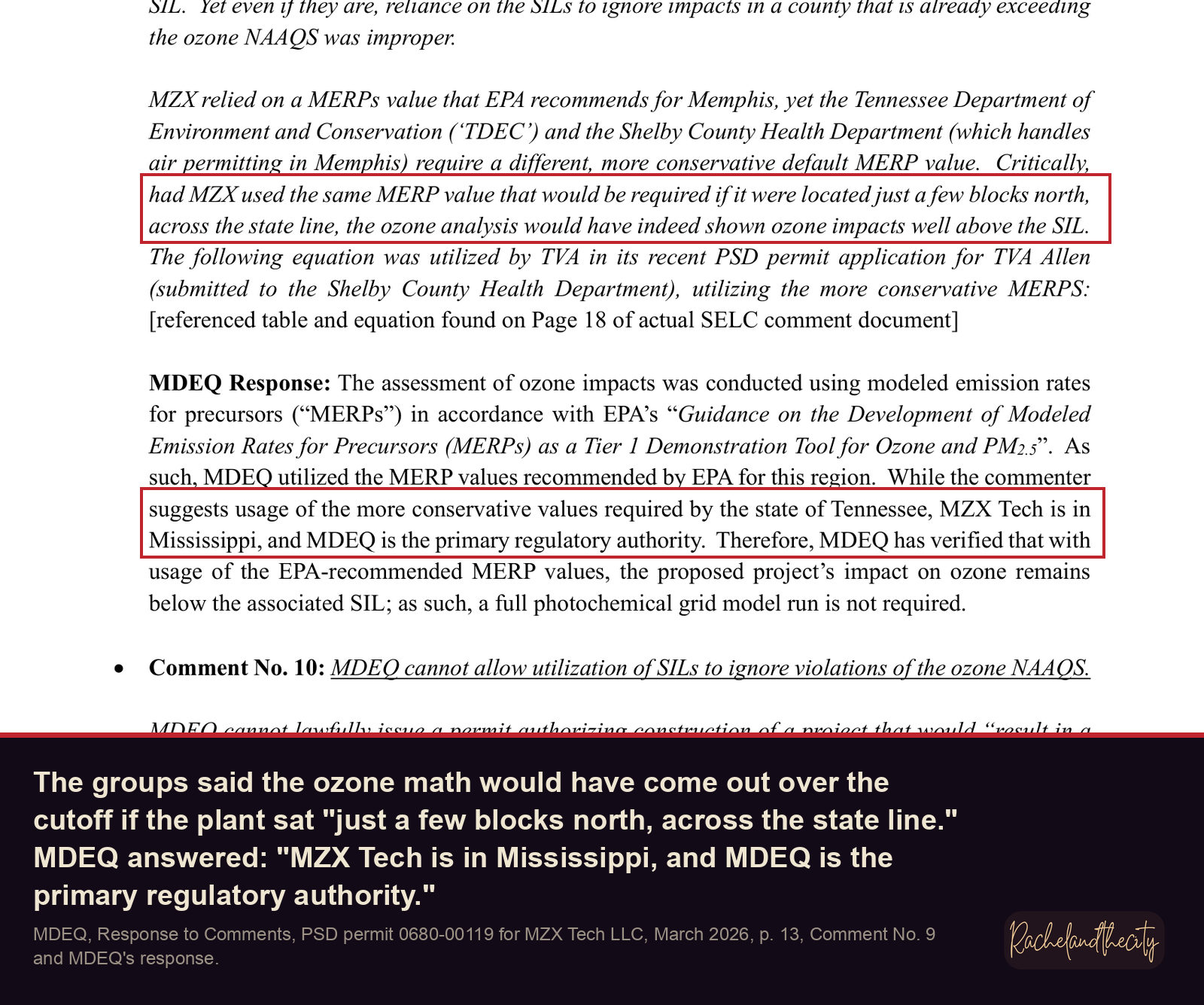
So, legally – they’re right.
The Clean Air Act gives the permit to the state where the smokestack sits. Using the EPA’s numbers for the region is normal, too. MDEQ even wrote that the Memphis area’s ozone is “near or above” the federal limit. But it said regulators can’t deny a permit based on the region’s air alone if one plant’s share is under the cutoff.
To be fair, the EPA’s own ozone data doesn’t show things getting worse, either. At the area’s long-running monitors, nothing jumped after xAI showed up in Memphis in 2024. Every one of them reads flat or lower in 2025, and in this year’s early numbers through mid-September.
That’s how the system’s built. The rules stop at the state line – even if the air doesn’t.
And Mississippi told Tennessee about the permit. On Friday, January 16th of this year, at 6:09 PM, MDEQ’s air chief emailed three people. One was at Shelby County, one in Tennessee state government, and one in Arkansas.
The email says the hearing notice is attached. But the list of attachments shows the draft permit twice and no hearing notice. That doesn’t prove they didn’t get it. It just means that email doesn’t show it.
Then the comments came in.
By MDEQ’s own count, 199 people and groups wrote in against the permit. Thirty people spoke at Mississippi’s public hearing in Southaven on February 17th, and not one of them spoke for it.
Memphis showed up, too. The Memphis branch of the NAACP and Memphis Community Against Pollution both spoke. So did Tennessee State Rep. Justin J. Pearson of Memphis, who also wrote in twice.
MDEQ put every comment and its answers in one packet that runs almost 1,600 pages.
But it includes no comments from Shelby County government or its health department. There’s nothing in it from the City of Memphis, the city’s utility MLGW, the Tennessee Valley Authority, or any Tennessee state agency.
Maybe they read it and just figured it wasn’t their call – and by law, it isn’t. None of them can approve or block a permit in Mississippi.
A neighbor can speak up, though.
In April 2025, Shelby County was permitting xAI’s turbines at Colossus 1. Arkansas’s environmental department sent the county a letter signed by its secretary, Shane Khoury. It asked the county to “consider the more stringent evaluation standard.”
Arkansas said Crittenden County, right across the river, sits in the same ozone area as Memphis. So Arkansas called itself “a stakeholder.”
So, Arkansas’s leaders spoke up for Arkansas. On Mississippi’s permit, MDEQ’s record has nothing like that from Memphis’s government.
And guess what? Section 126 of the Clean Air Act lets “any State or political subdivision” ask the EPA for a ruling.
A political subdivision means a city or a county. They can ask the EPA to rule that a major plant in the next state is sending over more pollution than the law allows. Then the EPA has to hold a public hearing and decide.
As far as the permit record and the news coverage show, nobody has used it on this plant. So – make another tick on the board showing our leaders didn’t fight for their citizens to have a voice in what’s happening.
On November 9th, three groups in Jackson make their case against the permit. They’re the NAACP, Young, Gifted & Green, and the Safe and Sound Coalition. None of them is our government.
So what did Shelby County and Tennessee do with that Friday email?
The record doesn’t say. So on October 19th, I asked both Shelby County and Tennessee’s environmental department. Neither one has answered yet.
One Tennessee official did write in, though: Justin Pearson.
He sent his comment through the contact form on MDEQ’s website at 5:30 PM, about half an hour before the Southaven hearing started. He wrote about “my constituents in Westwood and Whitehaven.” Those are the same two Memphis neighborhoods the health study flagged.
Then he wrote four words: “We share the air.”
If you like facts-first info on all this, consider leaving a tip on Venmo or PayPal – this stuff takes a lot of time to put together. And check out everything I’ve written with citations and receipts at the xAI Files.
Sources
- The records behind this essay, all in one place
- MZX Tech’s modeling plan, final version, November 5th, 2025 – section 1 says the plant “will provide electricity to its data center located in Shelby County, Tennessee”
- xAI’s sworn statement that the turbines were “the only available power source” (Jacobson declaration, June 15th, 2026, NAACP v. X.AI)
- The second xAI sworn statement, same day (Trettel declaration, June 15th, 2026)
- MDEQ Permit Board minutes, March 10th, 2026 – the permit approved, and MDEQ’s count of 199 written commenters
- MDEQ Permit Board minutes, August 11th, 2026 – the hearing set for November 9th and 10th
- Earlier in this series: What You Should Know About Mississippi’s Upcoming Hearing on xAI’s Turbines (October 1st)
- Earlier in this series: Did the University of Memphis just settle the xAI air fight? (September 16th)
- EmPower Analytics Group for SELC, Air Quality, Health, and Economic Impacts of the Proposed MZX Tech Facility, February 13th, 2026
- MDEQ’s Response to Comments on permit 0680-00119, March 2026 – p. 3 (the health study), p. 7 (0.797 ppb), pp. 12-14 (Tennessee’s values and “MZX Tech is in Mississippi”)
- North Carolina v. TVA, the federal appeals court ruling of July 26th, 2010
- EPA’s daily ozone monitor data
- MDEQ’s email to Shelby County, Tennessee and Arkansas, January 16th, 2026, 6:09 PM
- The certified transcript of MDEQ’s public hearing in Southaven, February 17th, 2026
- MDEQ’s full comment packet for the permit, 1,599 pages (the public xAI Files archive)
- Arkansas Department of Energy and Environment, letter to the Shelby County Health Department, April 30th, 2025
- Clean Air Act section 126
- Tennessee State Rep. Justin J. Pearson’s two comments to MDEQ, February 17th, 2026
- My records requests to Shelby County and TDEC, October 19th, 2026